Monday, 25 September 2023

Image Generator, Video Generator, AI Tools

https://www.highcpmrevenuegate.com/du6dem5hf?key=1bd8e18806d0968b434b8c498e345046

Are you looking for free tools to earn?

you are at right place!!

Here Down Blow Tools Can Earn You Upto $1000+ 

List of Artificial Intelligence Tools

Here, let’s learn about the numerous AI automation tools that are used in the industry today.

This blog covers the following tools:

Check out this YouTube video on Top 10 ChatGPT Alternatives to use in 2023:

1. ChatGPT

The most popular AI tool in the current market is ChatGPT, a text-based AI model developed by OpenAI. One of its standout features is the ChatGPT plugins, particularly designed to enhance human productivity and efficiency. These versatile plugins find applications across a wide range of domains, including SEO, coding, finance, design, and numerous others, delivering top-notch results for humans.

2. Google Bard

The top rival of ChatGPT is Google Bard, which is referred as a conversational generative artificial intelligence chatbot created by Google. Google Bard can chat with people and hold interactive conversations. It uses advanced AI technologies like LaMDA, PaLM, Imagen, and MusicLM. These technologies are being used to come up with innovative ways to interact with information, including language, images, videos, and audio, making the tool quite powerful.

3. Chatsonic

ChatSonic is a smart AI tool made by Writesonic. It helps companies make their conversations with customers more special using AI. It uses fancy computer learning and has pre-written conversations to sound like a human. ChatSonic can also make text and pictures, and it looks up useful stuff from Google to give even better answers.

4. Midjourney

Midjourney is the most popular AI art generator tool that uses AI (Artificial Intelligence) to generate art. It’s like having a virtual artist that creates artwork for you. It uses sophisticated AI algorithms, particularly deep learning neural networks, to create art. These algorithms can analyze and understand patterns, styles, and artistic elements from existing artworks.

5. DALL-E 

In 2023, DALL-E was developed by OpenAI which has earned a reputation as the leading AI tool for designers. This innovative tool has the capability to generate lifelike images based on textual descriptions. Although it’s currently in beta, it has the potential to revolutionize image creation by enhancing creativity using its advanced diffusion model.

6. SlidesAI

SlidesAI referred as a top AI PowerPoint generator tool, is a software or platform designed to assist users in creating and enhancing presentations using artificial intelligence (AI) capabilities. SlidesAI uses AI algorithms to automatically generate content for PowerPoint presentations. This content can include text, images, charts, and even layout suggestions. Users can input their presentation topic or key points, and the AI generates slides accordingly.

7. Alli AI

Alli AI stands out as a top-notch AI tool for SEO as it makes SEO tasks easier for companies. For busy marketers, finding tools that simplify their work is crucial. With this tool, you can also test different keywords on your pages and automatically keep the one that works best after the testing is done. With this tool, tracking and reporting can easily be done by accurately measuring the effectiveness of your SEO efforts and making informed decisions.

8. Jasper AI

Jasper AI is the best content generator AI tool that uses natural language processing (NLP) and machine learning algorithms to assist writers in generating content more efficiently. These tools can help with tasks such as creating blog posts, articles, product descriptions, and social media content by offering suggestions, auto-generating text, or assisting with grammar and style.

9. Paradox

Paradox.ai is a HRM software that helps companies to choose the best candidates for their job openings. It uses a friendly AI assistant called Olivia to do this. Paradox.ai makes it easier for companies to find the best job candidates, increase the number of people they hire, and answer common questions.

10. Synthesia

In order to create videos from written information, Synthesia stands out as a top artificial intelligence (AI) video generator tool. This tool offers a rapid and user-friendly approach to crafting high-quality videos. It caters to businesses seeking training or marketing materials, educational institutions producing instructional content, and individuals creating videos for personal or professional use.

11. aiXcoder

aiXcoder stands out as the best AI tool for coding, offering the capability to generate code at the method-level directly from natural language input. It also provides intelligent code completion for entire sections or multiple lines of code. This tool assist users to seamlessly incorporate suggested code from aiXcoder or continue writing to receive immediate, contextually-driven feedback.

12. TabNine

Tabnine serves as an AI code assistant trusted by a global community of over a million developers across numerous companies. It offers tailored code suggestions that greatly enhance efficiency, simplifying repetitive coding tasks and yielding top-tier, industry-standard code. Tabnine utilizes a Large Language Model (LLM) trained on reputable open-source code with permissive licenses, StackOverflow Q&A, and even your entire codebase (Enterprise feature). This means it generates more relevant, higher quality, more secure code than ChatGPT 4 or other tools on the market. 

13. DeepBrain AI

DeepBrain AI has proven its world-class conversational artificial intelligence technology to be highly utilizing in many areas, including broadcasting, education, and in service industry. The main goal of DeepBrain AI is to build a connection with your viewers by elevating your training videos using hyper-realistic AI avatars offered by DeepBrain to infuse them with a lifelike quality.

14. SecondBrain 

Previously recognized as MagicChat, SecondBrain helps you to construct ChatGPT-like bots equipped with in-depth familiarity with your business or product, bolstering your sales and customer service initiatives. By utilizing various content sources such as webpages, files, and documents, you have the capability to train your bot on how to provide immediate assistance to users visiting your website with inquiries about your services.

15. Textio

Textio is an AI-powered talent acquisition tool designed to craft job descriptions and provide guidance for performance reviews. Its primary goal is to eliminate bias in the hiring process and foster the creation of a more inclusive and diverse workforce. Textio guides recruiting teams to quickly optimize job posts and candidate outreach with inclusive, on-brand language. 

16. Wordtune

Wordtune is an AI powered reading and writing companion capable of fixing grammatical errors, understanding context and meaning, suggesting paraphrases or alternative writing tones, and generating written text based on context. Wordtune seamlessly integrates with widely used work tools such as Microsoft Word, iOS, and Google Chrome, enhancing the editing and writing process for a more efficient work experience.

17. Figstack

Figstack provides a comprehensive set of artificial intelligence tools designed to support developers in comprehending and documenting code more effectively. Its diverse array of features is geared towards simplifying the coding process, featuring a natural language interpreter capable of understanding code in nearly any programming language

18. Descript

Descript is an all-inclusive AI-powered video editing tool that enables you to swiftly produce polished videos. It offers the capability to incorporate diverse visual elements, titles, captions, and even animate layers. With Descript, you can seamlessly include voiceovers in your video, providing a selection of stock voices or the option to replicate your own. There’s also a restricted free plan accessible for users.

19. INK

This AI-powered tool integrates three key components: an AI writer, an SEO optimization tool, and a content planner. These elements can be employed separately or as a comprehensive package known as the INK Suite. The objective of this application is to streamline the writing process by consolidating various tools that writers typically utilize to deliver a seamless user experience that consists of various aspects of the writing process.

20. LyricStudio

For songwriters and musicians, this versatile AI tool helps in creating distinct lyrics suitable for any music genre. Once you choose your topic, LyricStudio presents a range of lyric choices through its “Smart Suggestions” feature. Additionally, it assists in locating rhymes for particular words. To get started, you can initiate a complimentary trial by setting up an account.

21. Scikit Learn

Scikit-Learn is a widely praised Artificial Intelligence (AI) tool that simplifies the complexities of machine learning tasks. It boasts an intuitive and user-friendly interface that caters to learners across different proficiency levels. Scikit-Learn provides extensive functions encompassing crucial areas like data preprocessing, model selection, and evaluation. Its repertoire spans various algorithms, encompassing classification, regression, clustering, and dimensionality reduction. Leveraging its rich collection of tools and comprehensive documentation, Scikit-Learn equips users with the means to construct and deploy machine learning models effortlessly.

Get your Master’s Degree in AI with Job Assistance by enrolling in Master’s in Artificial Intelligence in Australia.

22. TensorFlow

CurrentlyTensorFlow is the most sought-after deep learning library. This machine learning framework by Google is a Python-friendly open-source library. It is one of the best AI development tools that facilitate numerical computation making future predictions much easier and more accurate. But how?

Instead of getting entangled in the nitty-gritty of algorithms, developers can focus on the logic part of the application. TensorFlow takes care of everything that goes on the back end. The tool allows developers to construct neural networks and create graphical visualization using Tensorboard. TensorFlow applications can be run conveniently on your local machine, cloud, Android, and iOS devices. As it is built on a deployable scale, it runs on CPU AND GPU.

Learn about the production rule system to create AI algorithms in this comprehensive blog on Production Systems in AI.

Next on the list of Artificial Intelligence tools is PyTorch.

23. PyTorch

Next in competition for AI tools is PyTorch, which is also built on Python. This is similar to TensorFlow in terms of the nature of the projects chosen. However, when the priority is for faster development, PyTorch is the better choice. TensorFlow is gone in case the project involves larger and more complex projects.

Now, let us learn about CNTK, which is also one of the best Artificial Intelligence tools.

Want to learn Artificial Intelligence in-depth, check out this Artificial Intelligence Tutorial!

24. CNTK

This is a Microsoft Cognitive Toolkit, that is also built on similar lines as TensorFlow, but is not as easy to deploy. It has a broader range of APIs such as Python, Java, C, and C++ and mainly focuses on creating deep learning neural networks.

Further, let’s learn about Caffe which is yet another popular Artificial Intelligence tool in the market today.

Learn more about expert systems in artificial intelligence.

25. Caffe

This open-source, developed at the University of California, has a Python interface. It has its best application in academic research projects and industrial disposition. It is among the best tools used in Artificial Intelligence. This is attributed to its processing power which exceeds 60 million images per day.

Certification in Bigdata Analytics

26. Apache MXNet

This Artificial Intelligence tool is adopted by Amazon as its deep learning framework on AWS. Unlike other tools, this is not directly owned by a major corporation, which provides a conducive environment for an open-source framework.

It can run smoothly on multiple GPUs and machines. Also supports a range of APIs like Python, C++, Scala, R, JavaScript, Julia, Perl, and Go.

Now, you will learn about Keras which is among the most frequently used Artificial Intelligence tools.

Learn about key differences between Keras and TensorFlow in this comparison blog on Keras vs TensorFlow.

Get 100% Hike!

Master Most in Demand Skills Now !


https://www.highcpmrevenuegate.com/du6dem5hf?key=1bd8e18806d0968b434b8c498e345046

What Is Artificial Intelligence and it's uses

 WHAT IS ARTIFICIAL INTELLIGENCE? AND WHAT ARE IT USES? HOW TO MAKE A CHATGPT?

BLOG BY: MAZHAR HUSSAIN

What is artificial intelligence (AI)?

Artificial intelligence is the simulation of human intelligence processes by machines, especially computer systems. Specific applications of AI include expert systemsnatural language processing, speech recognition and machine vision.

How does AI work?

As the hype around AI has accelerated, vendors have been scrambling to promote how their products and services use it. Often, what they refer to as AI is simply a component of the technology, such as machine learning. AI requires a foundation of specialized hardware and software for writing and training machine learning algorithms. No single programming language is synonymous with AI, but Python, R, Java, C++ and Julia have features popular with AI developers.

In general, AI systems work by ingesting large amounts of labeled training data, analyzing the data for correlations and patterns, and using these patterns to make predictions about future states. In this way, a chatbot that is fed examples of text can learn to generate lifelike exchanges with people, or an image recognition tool can learn to identify and describe objects in images by reviewing millions of examples. New, rapidly improving generative AI techniques can create realistic text, images, music and other media.

AI programming focuses on cognitive skills that include the following:

  • Learning. This aspect of AI programming focuses on acquiring data and creating rules for how to turn it into actionable information. The rules, which are called algorithms, provide computing devices with step-by-step instructions for how to complete a specific task.
  • Reasoning. This aspect of AI programming focuses on choosing the right algorithm to reach a desired outcome.
  • Self-correction. This aspect of AI programming is designed to continually fine-tune algorithms and ensure they provide the most accurate results possible.
  • Creativity. This aspect of AI uses neural networks, rules-based systems, statistical methods and other AI techniques to generate new images, new text, new music and new ideas.

Differences between AI, machine learning and deep learning

AImachine learning and deep learning are common terms in enterprise IT and sometimes used interchangeably, especially by companies in their marketing materials. But there are distinctions. The term AI, coined in the 1950s, refers to the simulation of human intelligence by machines. It covers an ever-changing set of capabilities as new technologies are developed. Technologies that come under the umbrella of AI include machine learning and deep learning.

Machine learning enables software applications to become more accurate at predicting outcomes without being explicitly programmed to do so. Machine learning algorithms use historical data as input to predict new output values. This approach became vastly more effective with the rise of large data sets to train on. Deep learning, a subset of machine learning, is based on our understanding of how the brain is structured. Deep learning's use of artificial neural networks structure is the underpinning of recent advances in AI, including self-driving cars and ChatGPT.

Why is artificial intelligence important?

AI is important for its potential to change how we live, work and play. It has been effectively used in business to automate tasks done by humans, including customer service work, lead generation, fraud detection and quality control. In a number of areas, AI can perform tasks much better than humans. Particularly when it comes to repetitive, detail-oriented tasks, such as analyzing large numbers of legal documents to ensure relevant fields are filled in properly, AI tools often complete jobs quickly and with relatively few errors. Because of the massive data sets it can process, AI can also give enterprises insights into their operations they might not have been aware of. The rapidly expanding population of generative AI tools will be important in fields ranging from education and marketing to product design.


Indeed, advances in AI techniques have not only helped fuel an explosion in efficiency, but opened the door to entirely new business opportunities for some larger enterprises. Prior to the current wave of AI, it would have been hard to imagine using computer software to connect riders to taxis, but Uber has become a Fortune 500 company by doing just that.

AI has become central to many of today's largest and most successful companies, including Alphabet, Apple, Microsoft and Meta, where AI technologies are used to improve operations and outpace competitors. At Alphabet subsidiary Google, for example, AI is central to its search engine, Waymo's self-driving cars and Google Brain, which invented the transformer neural network architecture that underpins the recent breakthroughs in natural language processing.

What are the advantages and disadvantages of artificial intelligence?

Artificial neural networks and deep learning AI technologies are quickly evolving, primarily because AI can process large amounts of data much faster and make predictions more accurately than humanly possible.

While the huge volume of data created on a daily basis would bury a human researcher, AI applications using machine learning can take that data and quickly turn it into actionable information. As of this writing, a primary disadvantage of AI is that it is expensive to process the large amounts of data AI programming requires. As AI techniques are incorporated into more products and services, organizations must also be attuned to AI's potential to create biased and discriminatory systems, intentionally or inadvertently.

Advantages of AI

The following are some advantages of AI.

  • Good at detail-oriented jobs. AI has proven to be as good or better than doctors at diagnosing certain cancers, including breast cancer and melanoma.
  • Reduced time for data-heavy tasks. AI is widely used in data-heavy industries, including banking and securities, pharma and insurance, to reduce the time it takes to analyze big data sets. Financial services, for example, routinely use AI to process loan applications and detect fraud.
  • Saves labor and increases productivity. An example here is the use of warehouse automation, which grew during the pandemic and is expected to increase with the integration of AI and machine learning.
  • Delivers consistent results. The best AI translation tools deliver high levels of consistency, offering even small businesses the ability to reach customers in their native language.
  • Can improve customer satisfaction through personalization. AI can personalize content, messaging, ads, recommendations and websites to individual customers.
  • AI-powered virtual agents are always available. AI programs do not need to sleep or take breaks, providing 24/7 service.

Disadvantages of AI

The following are some disadvantages of AI.

  • Expensive.
  • Requires deep technical expertise.
  • Limited supply of qualified workers to build AI tools.
  • Reflects the biases of its training data, at scale.
  • Lack of ability to generalize from one task to another.
  • Eliminates human jobs, increasing unemployment rates.

Strong AI vs. weak AI

AI can be categorized as weak or strong.

  • Weak AI, also known as narrow AI, is designed and trained to complete a specific task. Industrial robots and virtual personal assistants, such as Apple's Siri, use weak AI.
  • Strong AI, also known as artificial general intelligence (AGI), describes programming that can replicate the cognitive abilities of the human brain. When presented with an unfamiliar task, a strong AI system can use fuzzy logic to apply knowledge from one domain to another and find a solution autonomously. In theory, a strong AI program should be able to pass both a Turing test and the Chinese Room argument.

What are the 4 types of artificial intelligence?

Arend Hintze, an assistant professor of integrative biology and computer science and engineering at Michigan State University, explained that AI can be categorized into four types, beginning with the task-specific intelligent systems in wide use today and progressing to sentient systems, which do not yet exist. The categories are as follows.

  • Type 1: Reactive machines. These AI systems have no memory and are task-specific. An example is Deep Blue, the IBM chess program that beat Garry Kasparov in the 1990s. Deep Blue can identify pieces on a chessboard and make predictions, but because it has no memory, it cannot use past experiences to inform future ones.
  • Type 2: Limited memory. These AI systems have memory, so they can use past experiences to inform future decisions. Some of the decision-making functions in self-driving cars are designed this way.
  • Type 3: Theory of mind. Theory of mind is a psychology term. When applied to AI, it means the system would have the social intelligence to understand emotions. This type of AI will be able to infer human intentions and predict behavior, a necessary skill for AI systems to become integral members of human teams.
  • Type 4: Self-awareness. In this category, AI systems have a sense of self, which gives them consciousness. Machines with self-awareness understand their own current state. This type of AI does not yet exist.
four types of ai.

DAVID PETERSSON

These are commonly described as the four main types of AI.

What are examples of AI technology and how is it used today?

AI is incorporated into a variety of different types of technology. Here are seven examples.

Automation. When paired with AI technologies, automation tools can expand the volume and types of tasks performed. An example is robotic process automation (RPA), a type of software that automates repetitive, rules-based data processing tasks traditionally done by humans. When combined with machine learning and emerging AI tools, RPA can automate bigger portions of enterprise jobs, enabling RPA's tactical bots to pass along intelligence from AI and respond to process changes.

Machine learning. This is the science of getting a computer to act without programming. Deep learning is a subset of machine learning that, in very simple terms, can be thought of as the automation of predictive analytics. There are three types of machine learning algorithms:

  • Supervised learning. Data sets are labeled so that patterns can be detected and used to label new data sets.
  • Unsupervised learning. Data sets aren't labeled and are sorted according to similarities or differences.
  • Reinforcement learning. Data sets aren't labeled but, after performing an action or several actions, the AI system is given feedback.

Machine vision. This technology gives a machine the ability to see. Machine vision captures and analyzes visual information using a camera, analog-to-digital conversion and digital signal processing. It is often compared to human eyesight, but machine vision isn't bound by biology and can be programmed to see through walls, for example. It is used in a range of applications from signature identification to medical image analysis. Computer vision, which is focused on machine-based image processing, is often conflated with machine vision.

Natural language processing (NLP). This is the processing of human language by a computer program. One of the older and best-known examples of NLP is spam detection, which looks at the subject line and text of an email and decides if it's junk. Current approaches to NLP are based on machine learning. NLP tasks include text translation, sentiment analysis and speech recognition.

Robotics. This field of engineering focuses on the design and manufacturing of robots. Robots are often used to perform tasks that are difficult for humans to perform or perform consistently. For example, robots are used in car production assembly lines or by NASA to move large objects in space. Researchers also use machine learning to build robots that can interact in social settings.

Self-driving cars. Autonomous vehicles use a combination of computer vision, image recognition and deep learning to build automated skills to pilot a vehicle while staying in a given lane and avoiding unexpected obstructions, such as pedestrians.

Text, image and audio generation. Generative AI techniques, which create various types of media from text prompts, are being applied extensively across businesses to create a seemingly limitless range of content types from photorealistic art to email responses and screenplays.

components of ai.
AI is not just one technology.

What are the applications of AI?

Artificial intelligence has made its way into a wide variety of markets. Here are 11 examples.

AI in healthcare. The biggest bets are on improving patient outcomes and reducing costs. Companies are applying machine learning to make better and faster medical diagnoses than humans. One of the best-known healthcare technologies is IBM Watson. It understands natural language and can respond to questions asked of it. The system mines patient data and other available data sources to form a hypothesis, which it then presents with a confidence scoring schema. Other AI applications include using online virtual health assistants and chatbots to help patients and healthcare customers find medical information, schedule appointments, understand the billing process and complete other administrative processes. An array of AI technologies is also being used to predict, fight and understand pandemics such as COVID-19.

AI in business. Machine learning algorithms are being integrated into analytics and customer relationship management (CRM) platforms to uncover information on how to better serve customers. Chatbots have been incorporated into websites to provide immediate service to customers. The rapid advancement of generative AI technology such as ChatGPT is expected to have far-reaching consequences: eliminating jobs, revolutionizing product design and disrupting business models.

AI in education. AI can automate grading, giving educators more time for other tasks. It can assess students and adapt to their needs, helping them work at their own pace. AI tutors can provide additional support to students, ensuring they stay on track. The technology could also change where and how students learn, perhaps even replacing some teachers. As demonstrated by ChatGPT, Bard and other large language models, generative AI can help educators craft course work and other teaching materials and engage students in new ways. The advent of these tools also forces educators to rethink student homework and testing and revise policies on plagiarism.

AI in finance. AI in personal finance applications, such as Intuit Mint or TurboTax, is disrupting financial institutions. Applications such as these collect personal data and provide financial advice. Other programs, such as IBM Watson, have been applied to the process of buying a home. Today, artificial intelligence software performs much of the trading on Wall Street.

AI in law. The discovery process -- sifting through documents -- in law is often overwhelming for humans. Using AI to help automate the legal industry's labor-intensive processes is saving time and improving client service. Law firms use machine learning to describe data and predict outcomes, computer vision to classify and extract information from documents, and NLP to interpret requests for information.

AI in entertainment and media. The entertainment business uses AI techniques for targeted advertising, recommending content, distribution, detecting fraud, creating scripts and making movies. Automated journalism helps newsrooms streamline media workflows reducing time, costs and complexity. Newsrooms use AI to automate routine tasks, such as data entry and proofreading; and to research topics and assist with headlines. How journalism can reliably use ChatGPT and other generative AI to generate content is open to question.

AI in software coding and IT processes. New generative AI tools can be used to produce application code based on natural language prompts, but it is early days for these tools and unlikely they will replace software engineers soon. AI is also being used to automate many IT processes, including data entry, fraud detection, customer service, and predictive maintenance and security.

Security. AI and machine learning are at the top of the buzzword list security vendors use to market their products, so buyers should approach with caution. Still, AI techniques are being successfully applied to multiple aspects of cybersecurity, including anomaly detection, solving the false-positive problem and conducting behavioral threat analytics. Organizations use machine learning in security information and event management (SIEM) software and related areas to detect anomalies and identify suspicious activities that indicate threats. By analyzing data and using logic to identify similarities to known malicious code, AI can provide alerts to new and emerging attacks much sooner than human employees and previous technology iterations.

AI in manufacturing. Manufacturing has been at the forefront of incorporating robots into the workflow. For example, the industrial robots that were at one time programmed to perform single tasks and separated from human workers, increasingly function as cobots: Smaller, multitasking robots that collaborate with humans and take on responsibility for more parts of the job in warehouses, factory floors and other workspaces.

AI in banking. Banks are successfully employing chatbots to make their customers aware of services and offerings and to handle transactions that don't require human intervention. AI virtual assistants are used to improve and cut the costs of compliance with banking regulations. Banking organizations use AI to improve their decision-making for loans, set credit limits and identify investment opportunities.

AI in transportation. In addition to AI's fundamental role in operating autonomous vehicles, AI technologies are used in transportation to manage traffic, predict flight delays, and make ocean shipping safer and more efficient. In supply chains, AI is replacing traditional methods of forecasting demand and predicting disruptions, a trend accelerated by COVID-19 when many companies were caught off guard by the effects of a global pandemic on the supply and demand of goods.

Augmented intelligence vs. artificial intelligence

Some industry experts have argued that the term artificial intelligence is too closely linked to popular culture, which has caused the general public to have improbable expectations about how AI will change the workplace and life in general. They have suggested using the term augmented intelligence to differentiate between AI systems that act autonomously -- popular culture examples include Hal 9000 and The Terminator -- and AI tools that support humans.

  • Augmented intelligence. Some researchers and marketers hope the label augmented intelligence, which has a more neutral connotation, will help people understand that most implementations of AI will be weak and simply improve products and services. Examples include automatically surfacing important information in business intelligence reports or highlighting important information in legal filings. The rapid adoption of ChatGPT and Bard across industry indicates a willingness to use AI to support human decision-making.
  • Artificial intelligence. True AI, or AGI, is closely associated with the concept of the technological singularity -- a future ruled by an artificial superintelligence that far surpasses the human brain's ability to understand it or how it is shaping our reality. This remains within the realm of science fiction, though some developers are working on the problem. Many believe that technologies such as quantum computing could play an important role in making AGI a reality and that we should reserve the use of the term AI for this kind of general intelligence.

Ethical use of artificial intelligence

While AI tools present a range of new functionality for businesses, the use of AI also raises ethical questions because, for better or worse, an AI system will reinforce what it has already learned.

This can be problematic because machine learning algorithms, which underpin many of the most advanced AI tools, are only as smart as the data they are given in training. Because a human being selects what data is used to train an AI program, the potential for machine learning bias is inherent and must be monitored closely.

Anyone looking to use machine learning as part of real-world, in-production systems needs to factor ethics into their AI training processes and strive to avoid bias. This is especially true when using AI algorithms that are inherently unexplainable in deep learning and generative adversarial network (GAN) applications.

Explainability is a potential stumbling block to using AI in industries that operate under strict regulatory compliance requirements. For example, financial institutions in the United States operate under regulations that require them to explain their credit-issuing decisions. When a decision to refuse credit is made by AI programming, however, it can be difficult to explain how the decision was arrived at because the AI tools used to make such decisions operate by teasing out subtle correlations between thousands of variables. When the decision-making process cannot be explained, the program may be referred to as black box AI.

In summary, AI's ethical challenges include the following: bias, due to improperly trained algorithms and human bias; misuse, due to deepfakes and phishing; legal concerns, including AI libel and copyright issues; elimination of jobs; and data privacy concerns, particularly in the banking, healthcare and legal fields.

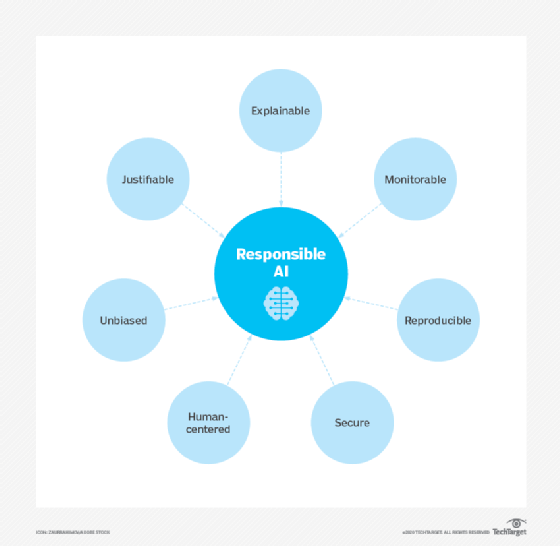
components of responsible AI use.
These components make up responsible AI use.

AI governance and regulations

Despite potential risks, there are currently few regulations governing the use of AI tools, and where laws do exist, they typically pertain to AI indirectly. For example, as previously mentioned, U.S. Fair Lending regulations require financial institutions to explain credit decisions to potential customers. This limits the extent to which lenders can use deep learning algorithms, which by their nature are opaque and lack explainability.

The European Union's General Data Protection Regulation (GDPR) is considering AI regulations. GDPR's strict limits on how enterprises can use consumer data already limits the training and functionality of many consumer-facing AI applications.

Policymakers in the U.S. have yet to issue AI legislation, but that could change soon. A "Blueprint for an AI Bill of Rights" published in October 2022 by the White House Office of Science and Technology Policy (OSTP) guides businesses on how to implement ethical AI systems. The U.S. Chamber of Commerce also called for AI regulations in a report released in March 2023.

Crafting laws to regulate AI will not be easy, in part because AI comprises a variety of technologies that companies use for different ends, and partly because regulations can come at the cost of AI progress and development. The rapid evolution of AI technologies is another obstacle to forming meaningful regulation of AI, as are the challenges presented by AI's lack of transparency that make it difficult to see how the algorithms reach their results. Moreover, technology breakthroughs and novel applications such as ChatGPT and Dall-E can make existing laws instantly obsolete. And, of course, the laws that governments do manage to craft to regulate AI don't stop criminals from using the technology with malicious intent.

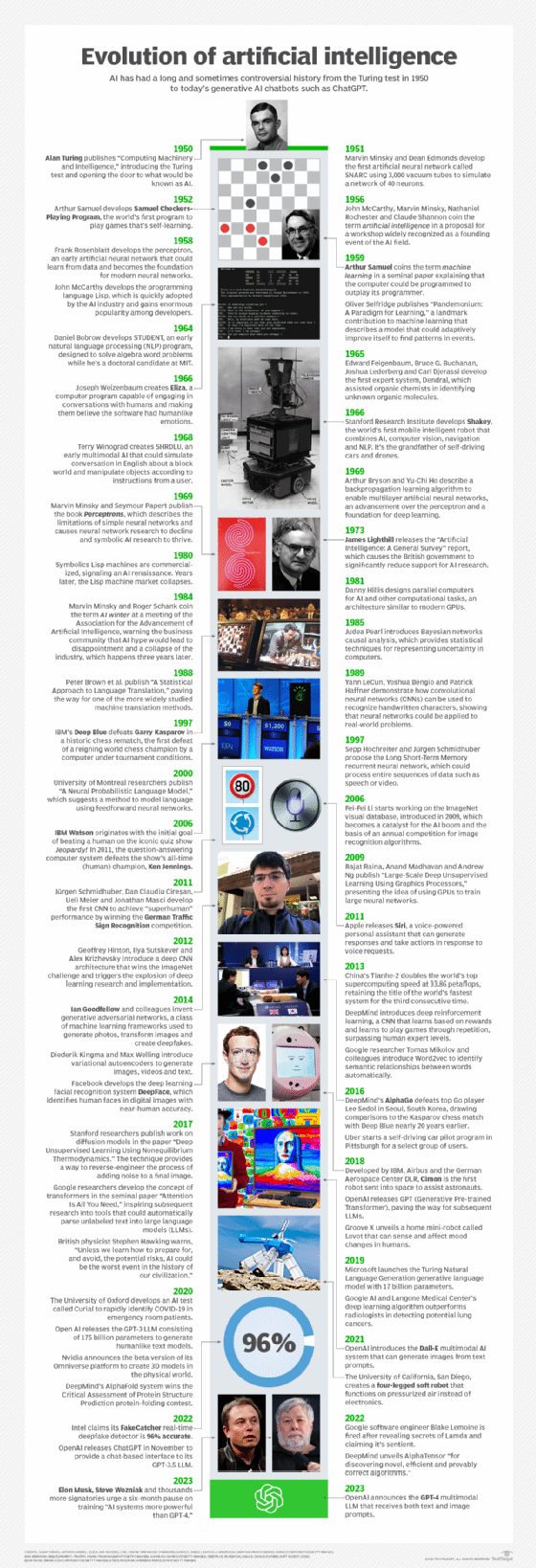
Milestones in AI from 1950 to present.
AI has had a long and sometimes controversial history from the Turing test in 1950 to today's generative AI chatbots like ChatGPT.

What is the history of AI?

The concept of inanimate objects endowed with intelligence has been around since ancient times. The Greek god Hephaestus was depicted in myths as forging robot-like servants out of gold. Engineers in ancient Egypt built statues of gods animated by priests. Throughout the centuries, thinkers from Aristotle to the 13th century Spanish theologian Ramon Llull to RenĂ© Descartes and Thomas Bayes used the tools and logic of their times to describe human thought processes as symbols, laying the foundation for AI concepts such as general knowledge representation.

The late 19th and first half of the 20th centuries brought forth the foundational work that would give rise to the modern computer. In 1836, Cambridge University mathematician Charles Babbage and Augusta Ada King, Countess of Lovelace, invented the first design for a programmable machine.

1940s. Princeton mathematician John Von Neumann conceived the architecture for the stored-program computer -- the idea that a computer's program and the data it processes can be kept in the computer's memory. And Warren McCulloch and Walter Pitts laid the foundation for neural networks.

1950s. With the advent of modern computers, scientists could test their ideas about machine intelligence. One method for determining whether a computer has intelligence was devised by the British mathematician and World War II code-breaker Alan Turing. The Turing test focused on a computer's ability to fool interrogators into believing its responses to their questions were made by a human being.

1956. The modern field of artificial intelligence is widely cited as starting this year during a summer conference at Dartmouth College. Sponsored by the Defense Advanced Research Projects Agency (DARPA), the conference was attended by 10 luminaries in the field, including AI pioneers Marvin Minsky, Oliver Selfridge and John McCarthy, who is credited with coining the term artificial intelligence. Also in attendance were Allen Newell, a computer scientist, and Herbert A. Simon, an economist, political scientist and cognitive psychologist. The two presented their groundbreaking Logic Theorist, a computer program capable of proving certain mathematical theorems and referred to as the first AI program.

1950s and 1960s. In the wake of the Dartmouth College conference, leaders in the fledgling field of AI predicted that a man-made intelligence equivalent to the human brain was around the corner, attracting major government and industry support. Indeed, nearly 20 years of well-funded basic research generated significant advances in AI: For example, in the late 1950s, Newell and Simon published the General Problem Solver (GPS) algorithm, which fell short of solving complex problems but laid the foundations for developing more sophisticated cognitive architectures; and McCarthy developed Lisp, a language for AI programming still used today. In the mid-1960s, MIT Professor Joseph Weizenbaum developed ELIZA, an early NLP program that laid the foundation for today's chatbots.

1970s and 1980s. The achievement of artificial general intelligence proved elusive, not imminent, hampered by limitations in computer processing and memory and by the complexity of the problem. Government and corporations backed away from their support of AI research, leading to a fallow period lasting from 1974 to 1980 known as the first "AI Winter." In the 1980s, research on deep learning techniques and industry's adoption of Edward Feigenbaum's expert systems sparked a new wave of AI enthusiasm, only to be followed by another collapse of government funding and industry support. The second AI winter lasted until the mid-1990s.

1990s. Increases in computational power and an explosion of data sparked an AI renaissance in the late 1990s that set the stage for the remarkable advances in AI we see today. The combination of big data and increased computational power propelled breakthroughs in NLP, computer vision, robotics, machine learning and deep learning. In 1997, as advances in AI accelerated, IBM's Deep Blue defeated Russian chess grandmaster Garry Kasparov, becoming the first computer program to beat a world chess champion.

2000s. Further advances in machine learning, deep learning, NLP, speech recognition and computer vision gave rise to products and services that have shaped the way we live today. These include the 2000 launch of Google's search engine and the 2001 launch of Amazon's recommendation engine. Netflix developed its recommendation system for movies, Facebook introduced its facial recognition system and Microsoft launched its speech recognition system for transcribing speech into text. IBM launched Watson and Google started its self-driving initiative, Waymo.

2010s. The decade between 2010 and 2020 saw a steady stream of AI developments. These include the launch of Apple's Siri and Amazon's Alexa voice assistants; IBM Watson's victories on Jeopardy; self-driving cars; the development of the first generative adversarial network; the launch of TensorFlow, Google's open source deep learning framework; the founding of research lab OpenAI, developers of the GPT-3 language model and Dall-E image generator; the defeat of world Go champion Lee Sedol by Google DeepMind's AlphaGo; and the implementation of AI-based systems that detect cancers with a high degree of accuracy.

2020s. The current decade has seen the advent of generative AI, a type of artificial intelligence technology that can produce new content. Generative AI starts with a prompt that could be in the form of a text, an image, a video, a design, musical notes or any input that the AI system can process. Various AI algorithms then return new content in response to the prompt. Content can include essays, solutions to problems, or realistic fakes created from pictures or audio of a person. The abilities of language models such as ChatGPT-3, Google's Bard and Microsoft's Megatron-Turing NLG have wowed the world, but the technology is still in early stages, as evidenced by its tendency to hallucinate or skew answers.

AI tools and services

AI tools and services are evolving at a rapid rate. Current innovations in AI tools and services can be traced to the 2012 AlexNet neural network that ushered in a new era of high-performance AI built on GPUs and large data sets. The key change was the ability to train neural networks on massive amounts of data across multiple GPU cores in parallel in a more scalable way.

Over the last several years, the symbiotic relationship between AI discoveries at Google, Microsoft, and OpenAI, and the hardware innovations pioneered by Nvidia have enabled running ever-larger AI models on more connected GPUs, driving game-changing improvements in performance and scalability.

The collaboration among these AI luminaries was crucial for the recent success of ChatGPT, not to mention dozens of other breakout AI services. Here is a rundown of important innovations in AI tools and services.

Transformers. Google, for example, led the way in finding a more efficient process for provisioning AI training across a large cluster of commodity PCs with GPUs. This paved the way for the discovery of transformers that automate many aspects of training AI on unlabeled data.

Hardware optimization. Just as important, hardware vendors like Nvidia are also optimizing the microcode for running across multiple GPU cores in parallel for the most popular algorithms. Nvidia claimed the combination of faster hardware, more efficient AI algorithms, fine-tuning GPU instructions and better data center integration is driving a million-fold improvement in AI performance. Nvidia is also working with all cloud center providers to make this capability more accessible as AI-as-a-Service through IaaS, SaaS and PaaS models.

Generative pre-trained transformers. The AI stack has also evolved rapidly over the last few years. Previously enterprises would have to train their AI models from scratch. Increasingly vendors such as OpenAI, Nvidia, Microsoft, Google, and others provide generative pre-trained transformers (GPTs), which can be fine-tuned for a specific task at a dramatically reduced cost, expertise and time. Whereas some of the largest models are estimated to cost $5 million to $10 million per run, enterprises can fine-tune the resulting models for a few thousand dollars. This results in faster time to market and reduces risk.

AI cloud services. Among the biggest roadblocks that prevent enterprises from effectively using AI in their businesses are the data engineering and data science tasks required to weave AI capabilities into new apps or to develop new ones. All the leading cloud providers are rolling out their own branded AI as service offerings to streamline data prep, model development and application deployment. Top examples include AWS AI ServicesGoogle Cloud AIMicrosoft Azure AI platform, IBM AI solutions and Oracle Cloud Infrastructure AI Services.

Cutting-edge AI models as a service. Leading AI model developers also offer cutting-edge AI models on top of these cloud services. OpenAI has dozens of large language models optimized for chat, NLP, image generation and code generation that are provisioned through Azure. Nvidia has pursued a more cloud-agnostic approach by selling AI infrastructure and foundational models optimized for text, images and medical data available across all cloud providers. Hundreds of other players are offering models customized for various industries and use cases as well.

George Lawton also contributed to this article.

Image Generator, Video Generator, AI Tools

https://www.highcpmrevenuegate.com/du6dem5hf?key=1bd8e18806d0968b434b8c498e345046 Are you looking for free tools to earn? you are at righ...